
Prospective families visiting your classical Christian school for the first time are not reading your mission statement on the wall. They’re looking around, absorbing the feeling of the place, watching how your staff carries themselves, noticing whether the hallways feel intentional or accidental. And at some point during that visit, something physical gets put in their hands. A folder. A brochure. Maybe a tote bag with a crest on it. Whatever that item is, it becomes part of the emotional evidence they carry home and reference when they’re sitting at the kitchen table that night trying to decide.
For a 90-student school with a part-time admissions coordinator and a merch budget that was probably negotiated down twice before it was approved, that’s a lot of weight for a tote bag to carry. The good news is that you don’t need a massive budget to get this right. You need intention, a cleaner aesthetic than the local Christian school down the road, and a clear understanding of what prospective families actually respond to.
The Download Every Small School Administrator Needs
If your school is still ordering merch based on what’s cheapest per unit, the Branded Merch Playbook will reframe how you’re thinking about this entirely. It walks through what types of branded products people actually hold onto versus what ends up in the recycling bin, with real product picks and honest pricing context so you can order fewer things and have them land harder.
Get the PlaybookWhy Admissions Events Are the Highest-Stakes Merch Moment You Have
Your school year has a lot of branded touchpoints, but almost none of them have the persuasion weight of an admissions event. Open houses, shadow days, admitted student nights, curriculum fairs — these are the moments when a family is actively deciding whether to commit financially and educationally to your school for the next several years, possibly a decade. The branded items that show up at those events aren’t just swag. They’re physical signals about whether your school is organized, thoughtful, and worth trusting.
For classical Christian schools specifically, there’s an added layer of expectation. The families you’re trying to attract have usually done serious research. They know what classical education means, they’ve read Susan Wise Bauer or Dorothy Sayers, and they’re comparing you to other schools in the movement. They are not going to be wowed by a glossy tri-fold brochure and a cheap pen with your name laser-engraved on it. They’re going to notice whether your presentation materials feel like they were assembled with the same care your curriculum was designed with.
The good news for small schools is that intimacy is an asset. You don’t need to impress 400 families at a recruiting fair. You need 12 families to walk away from your open house genuinely excited. That’s a very achievable objective if you treat every physical touchpoint at that event as an extension of your school’s character.
What Actually Belongs in an Admissions Event Merch Strategy
There are a few distinct categories to think through when you’re planning what to have on hand at an admissions event, and they serve different purposes.
Leave-behind kits are the most strategically important category. These are the materials families take home, sit with overnight, and look at again when they’re filling out the enrollment application or writing the deposit check. A well-designed folder or branded envelope that holds your information packet, curriculum overview, and tuition schedule is not a luxury — it’s the thing that keeps your school’s name physically present in the decision-making environment. Families often visit multiple schools within a few weeks, and the quality of the leave-behind kit is often what helps one school’s memory survive.
Event-day functional items serve families while they’re on campus and subtly signal that your school thought ahead. Branded name tags for staff, a cohesive look for any volunteers or parent ambassadors, water bottles or coffee cups at the welcome table — these aren’t glamorous, but they create an atmosphere of organization. A school that can’t pull off a coherent admissions event is telegraphing something families pick up on even if they can’t articulate it.
Takeaway gifts for kids are underused at classical Christian schools and almost absurdly effective. If a prospective family brings their elementary-aged child to your open house and that child leaves with a quality branded item — a kid-sized hoodie, a sticker sheet featuring the school crest, a quality pencil set — you’ve just created a stakeholder. That child is going to ask their parents about “the school with the cool hoodie.” Don’t underestimate how much the in-house lobbying of a nine-year-old influences the family decision.
The Design Challenge Small Schools Actually Face
For a school with 80 to 150 students, there’s a real tension in merch decisions around minimum order quantities and cost-per-unit. Most quality decorators require a minimum of 24 to 36 pieces for screen printing, which means a small school either over-orders (and has boxes of leftover inventory in the front office for three years) or under-orders (and runs out mid-event, which is its own kind of embarrassment).
The smarter approach for small schools is to focus on fewer, better items rather than a wide variety of budget options. A single well-chosen, well-designed crewneck sweatshirt in a neutral colorway — charcoal, navy, oatmeal — is infinitely more effective than four different shirt styles in five different colors where nothing matches and the whole display looks like a clearance bin. Classical Christian school families, almost without exception, have good taste. They notice when something is aesthetically coherent and when it isn’t.
This also applies to your actual admissions collateral. The printed materials that go inside your leave-behind folder need to feel like they belong in the same family as your branded items. If your brochure is printed on 60-lb stock and your folder is a cheap pressboard thing from the office supply store, but you’ve got a beautiful embroidered crewneck on the table, the inconsistency is jarring. Think about the whole presentation as a single designed experience, not individual items sourced separately.
The Merch Table Is Doing More Work Than You Think
At classical Christian school admissions events, the display of branded items is doing active recruitment work alongside your admissions coordinator. Families walk past the merch table and form impressions before a single word has been exchanged. A table with intentional presentation, quality items at visible price points, and a clean visual hierarchy reads as a school that operates with purpose. The opposite reads as a school that threw something together on a Thursday afternoon.
The insight behind treating your merch table as a frontline admissions tool is that it’s one of the few elements of your event that speaks to families who aren’t yet in conversation with a staff member. It’s selling the school passively, continuously, to everyone who glances at it. For a school trying to make a strong first impression on a limited budget, that’s valuable real estate.
Merch Touchpoints Throughout the Admissions Season
One of the more underappreciated aspects of admissions merch planning is that it shouldn’t just cover open house night. The classical school admissions season has a natural rhythm that creates several distinct merch touchpoints, and schools that think ahead can use each one strategically.
Shadow days, where a prospective student spends a day attending classes, are a particularly high-value moment. A student who shadows at your school and leaves with a quality branded item is going home with physical evidence of the experience. If that item is something they’d genuinely want to wear — a well-designed t-shirt, a quality water bottle with the school crest — it becomes a walking advertisement back to their peer group, which is exactly where classical Christian school enrollment conversations often start.
Admitted family orientation nights are another moment where merch does work. Families who have committed to the school but haven’t yet started are in an emotional state that’s receptive to belonging — they want to feel like they’ve made the right decision, and a welcome kit that includes quality branded items reinforces that feeling. The strategies around effective merch touches at school open house events apply equally well to these post-admission moments; the goal in both cases is to make the family feel like they’ve joined something worth being part of.
What Families Actually Keep Versus What They Don’t
Spend any time thinking about the branded items you’ve received from organizations over the years and you’ll notice a pattern: you kept the ones that were useful, that felt like something you’d actually choose, and that didn’t scream “budget item.” Everything else got donated or disappeared.
Families attending your admissions events are processing the same filter, even if they’re doing it unconsciously. A quality canvas tote with an embroidered school crest in a single tasteful color is an item that families use for grocery runs, farmers markets, and school pickup for years. A thin polyester bag with a full-color print that pills after two washes is something they feel slightly guilty throwing away, and then they throw it away anyway.
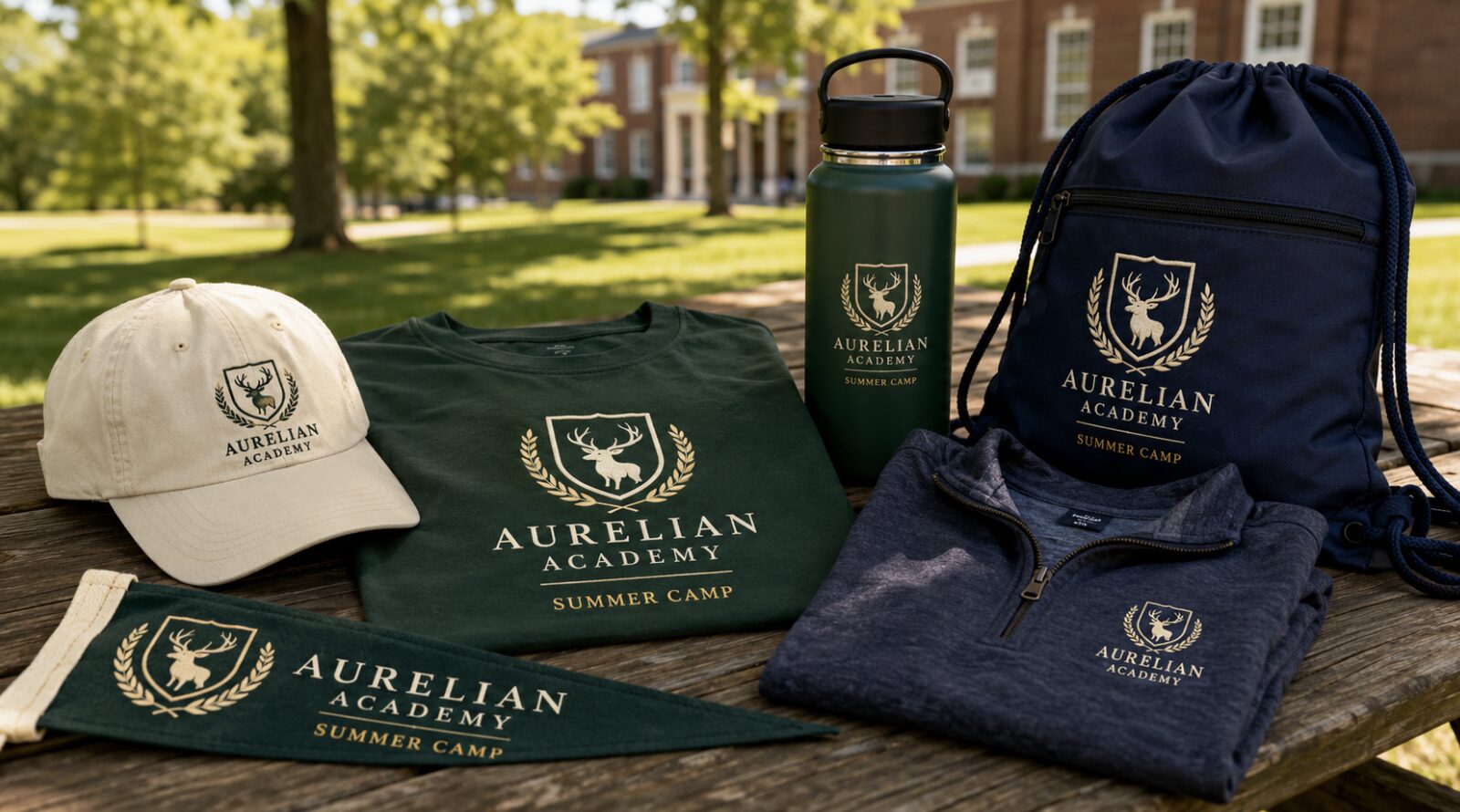
The framework for building a Christian school welcome kit that families genuinely keep starts with choosing items that have a life outside the admissions event itself. A branded journal, a quality pen, a crewneck for the kids, a tote for the parents — these all have daily utility that extends the school’s brand presence into the family’s normal life long after the open house ends. That’s the whole game. You want your school’s name in their hand at 7am on a Tuesday in March, not just on the night they toured your campus.
Building Your Admissions Merch Budget the Right Way
For a small classical Christian school, admissions merch doesn’t need to be a major line item to be effective. The goal is to identify two or three hero items per admissions cycle and do those well, rather than spreading a limited budget across ten mediocre things. A realistic starting point for most small private schools is allocating somewhere in the neighborhood of $15 to $25 per prospective family for the full leave-behind experience, which covers a quality folder, one or two printed pieces, and a small branded item. That’s enough to be memorable without being reckless.
The other thing worth remembering is that admissions merch is the one category where the cost of getting it wrong shows up in enrollment numbers. Prospective families are making a $10,000 to $20,000 annual financial commitment. A $20 per-family investment in a quality first impression is not an extravagance. It’s a sensible allocation for something that has a direct relationship to whether people write the check.




0 Comments